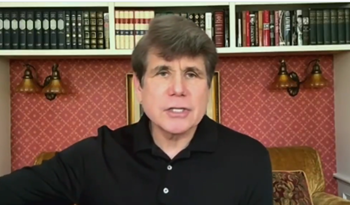
Rod Blagojevich has known Barack Obama since 1995.
That's not a footnote. That's the whole premise.
In 2007, when Obama was still a first-term senator from Illinois with an announcement to make, Blagojevich was the first sitting governor in the country to put his weight behind him. He was there in Springfield when Obama launched the campaign that took him to the White House. For more than a decade, they were partners in the same Illinois Democratic machine — two men who understood exactly how the game was played, and who played it together.
Which is why what Blagojevich posted on X last Thursday deserves more attention than it's getting.
His exact words: "I was the first Governor to endorse Obama for President back in 2007. I was there when he announced in Springfield Illinois. I have known him since 1995. Do I think it likely he ordered a phony intelligence assessment in December of 2016 to destroy Trump & his new administration? ABSOLUTELY!"
That's not a Republican talking point. That's not a pundit speculating from the outside. That's a man who was inside the Obama operation — the Illinois Democratic apparatus, the Chicago machine, the inner circle — for over a decade, saying he watched how this man makes decisions, and yes, this is exactly what he would do.
Here's the part the media won't tell you: Blagojevich isn't speculating about something unprovable. There's a paper trail.
On December 9, 2016 — one month after Trump won the election and six weeks before he took office — Obama ordered an intelligence assessment. His DNI James Clapper's assistant sent an email to intelligence leaders explicitly tasking them with the creation of an assessment "per the President's request." The Office of the Director of National Intelligence has since released a press release stating that new evidence "uncovers Obama-directed creation of false intelligence report used to launch a years-long effort to undermine President Trump." Obama's assessment was supposed to include China's hacking operations targeting American campaigns in 2008 and 2012. The final published document never mentioned China once. It focused entirely on Russia.
Former CIA Director John Ratcliffe described the result in January 2021: the assessment created a "false impression that Russia sought to influence the election, but China did not." He was explicit that the intelligence did not accurately reflect what the community actually knew.
Obama ordered the assessment. The assessment was shaped to tell one story. That story launched four years of investigations, impeachment attempts, and the systematic targeting of a sitting president and everyone around him.
Blagojevich — the man who was there when Obama announced in Springfield, who was the first governor to endorse him, who operated alongside him in Illinois politics from 1995 forward — is saying he ordered it. The documents coming out of the intelligence community are saying the same thing. One is a firsthand character witness. The other is a paper trail.
The standard dismissal will arrive on schedule: Blagojevich is a convicted felon. His 2011 corruption conviction, his sentence, his 8 years in federal prison before Trump commuted it, and his full pardon in February 2025 will all be deployed as reasons not to listen to him. But notice what that argument requires. It requires that a man who spent 30 years inside Chicago Democratic politics — who was the first governor to back Obama, who stood next to him at the beginning — somehow knows less about how Barack Obama operates than the journalists who covered him from a press credential distance.
He's not speculating about Obama's character. He's testifying about it.
Blagojevich is a free man, a pardoned man, and a man who no longer owes the Democratic machine anything. The party that could have protected him didn't. The man who gave him his freedom back was Donald Trump. He has no incentive to protect Obama's legacy and every reason to tell the truth about what he saw.
If you do a CTRL-F search in mainstream coverage of Blagojevich's post, you will find either nothing, or a version of the story that leads with his conviction and buries the 30-year relationship in paragraph seven. The endorsement, Springfield, 1995, the decades of watching the same man make the same kind of decisions — all of it disappears. Because the relationship is the story, and the relationship is the one thing they can't explain away.
This isn't a random accuser with a grudge. This is the man who was in the room when the habits were formed.
He had a front-row seat for thirty years. And he's done staying quiet about what he saw from it.