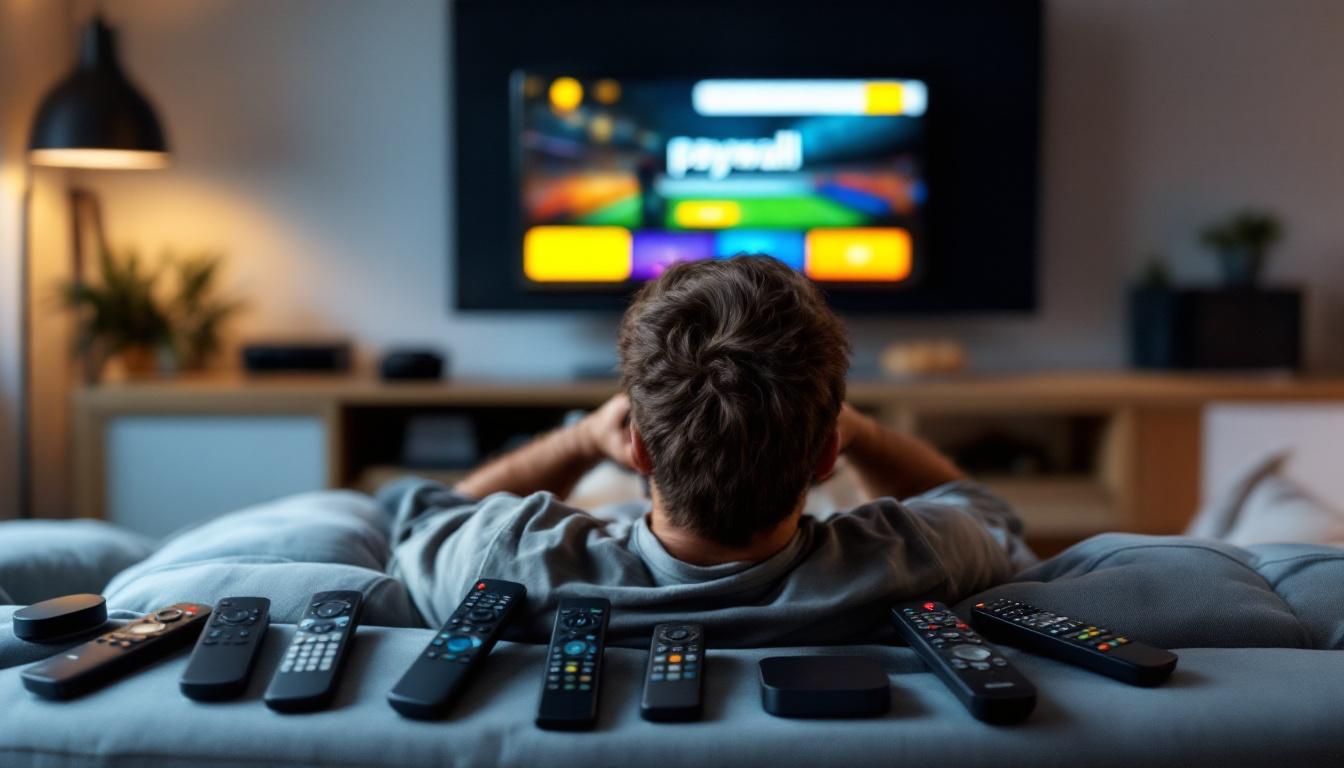
The Department of Justice just opened a formal antitrust investigation into the National Football League over its TV and streaming deals — because apparently it took the federal government until 2026 to notice that watching football now requires a second mortgage and subscriptions to ten different apps your wife doesn’t know about.
Welcome to the future of American sports, where you need Amazon Prime for Thursdays, Peacock for Sundays, Netflix for Christmas, ESPN+ for Mondays, YouTube TV for out-of-market games, and a PhD in computer science just to figure out which one of these apps is showing the Packers this week. Ka-ching!
Here’s how we got here. Back in 1961, Congress passed something called the Sports Broadcasting Act. The whole point of the law was simple: let the NFL negotiate TV deals as a league instead of 32 separate teams, so that games would be broadcast on free television for every American with an antenna and a recliner. Congress literally gave the NFL a special exemption from antitrust law — the kind of exemption that would land any other industry in federal court — specifically so the games would stay free.
Free. As in, you turn on the TV and the game is on. No credit card required. No “Start Your 7-Day Free Trial” pop-up blocking the third-down play.
So what did the NFL do with this generous legal gift from the American taxpayer? They took it, said “thanks,” and then sold your games to every streaming platform with a checkbook. The league is sitting on an 11-year, $111 billion media deal — that’s billion with a B — and they’re already pushing networks to renegotiate at rates 50 to 60 percent higher. CBS currently pays $2.1 billion a year for Sunday afternoon games, and the NFL reportedly wants to jack that above $3 billion.
And guess who pays for all of that? You do. Through subscriptions. Through price hikes. Through that mysterious $82.99 charge on your YouTube TV bill that you keep meaning to cancel but don’t because the Cowboys play on Sunday.
Sen. Mike Lee — Republican from Utah, chairman of the Senate Judiciary antitrust subcommittee, and apparently the only person in Washington who also can’t find the game on Sunday — fired off a letter to the DOJ back in March demanding they look into this. His quote is beautiful: “To watch every NFL game during this past season, football fans spent almost $1,000 on cable and streaming subscriptions.”
A thousand bucks. To watch football. Your grandfather watched every game for the price of adjusting the rabbit ears on top of a Zenith.
And it gets better. The FCC — under Trump-appointed Chairman Brendan Carr — calculated that the real number is actually north of $1,500 if you include basic cable and internet. Sportico pegged it at $935 for streaming alone. Forbes said $765 if you’re crafty about it. But no matter whose math you use, the answer is the same: the NFL took a sport that used to be free and turned it into a luxury item.
Think about that for a second. We’re not talking about courtside seats at the Lakers. We’re not talking about a skybox at the Super Bowl. We’re talking about sitting on your own couch, in your own house, watching a regular-season game between the Jaguars and the Titans — and you need a streaming subscription to do it.
(The Jaguars and the Titans! That’s not even a real game. That’s a punishment.)
Now here’s the legal angle that should make Roger Goodell’s $60-million-a-year salary feel a little less comfortable. The Sports Broadcasting Act — that 1961 antitrust exemption — only covers “sponsored telecasting.” Courts have already ruled that means free, ad-supported broadcasts available to the general public. Cable doesn’t count. Satellite doesn’t count. And streaming sure as heck doesn’t count.
Which means every time the NFL collectively negotiated a deal with Amazon, Netflix, or Peacock, they may have been operating outside their legal protection. Without the exemption, 32 teams negotiating as a cartel to fix prices and restrict where you can watch their product is textbook antitrust violation. The kind of thing that gets other industries hauled before Congress and broken up.
But wait — it gets even juicier. A jury already slapped the NFL with a $4.7 billion verdict in the Sunday Ticket antitrust case. With treble damages, that’s potentially $14.1 billion. A judge later tossed the verdict, but the fact that a jury of regular Americans looked at the NFL’s business model and said “yeah, that’s illegal” tells you everything you need to know about how the public feels.
Rep. Scott Fitzgerald — Republican from Wisconsin, home of the only publicly-owned franchise in the NFL — put it perfectly: “Wisconsin sports fans should have access to their teams’ games without having to pay for multiple cable and streaming packages.” Amen, Congressman. Preach.
The NFL’s response? They trotted out a spokesperson to claim that “over 87% of our games are on free, broadcast television.” Which sounds great until you realize that means 13% of the games — including playoffs — are locked behind paywalls. And if your team happens to be playing on one of those nights? Too bad. Cough up the subscription or listen on the radio like it’s 1943.
They also bragged that the 2025 season was the most-watched since 1989. Unbelievable. “We made it nearly impossible to watch our product legally without spending a fortune, and viewership still went up!” That’s not a defense, Roger. That’s an admission that you have a monopoly on the most popular sport in America and you’re exploiting it.
Here’s what we love about this story. This isn’t some abstract policy fight happening in a committee room that nobody cares about. This is the Trump DOJ going to bat for every dad in America who just wants to watch the game on Sunday without remortgaging the house. This is populism at its finest — the government saying to a bunch of billionaire team owners, “Hey, Congress gave you a special deal to keep football free, and you used it to shake down every fan in America. We’d like a word.”
The NFL thought they were untouchable. They thought the antitrust exemption was a blank check to do whatever they wanted with your football. They thought wrong.
Because now the same DOJ that’s been cleaning house everywhere else in Washington just kicked in the NFL’s front door. And if Roger Goodell doesn’t start sweating through that suit, he’s not paying attention.